This is the first of a 3-part series on human-agent teamwork. In part one (this article), we’ll cover “single-player” mode, in which team members run their own agents independently. Part two will explore “multi-player” mode, in which autonomous agents join teams. Part three takes the long view: what teams look like once human-agent teamwork is the default, not the exception. We’ll link to parts two and three here once they’re published.
Two people on the same team spent a week – and millions of tokens – solving the same problem. Neither found out until the retro.
Nobody caught it earlier because nobody could see it. The engineer has Claude Code working three branches before standup. The PM’s research briefs come out of a ChatGPT project she’s spent months tuning. The designer runs Figma files through an agent that drafts the specs. Output is way up, but the team can no longer answer the most basic question: who’s doing what, and why?
That’s human-agent teamwork, today. Nobody on that team would use the phrase – there’s no bot in the org chart. There’s just three people expensing their own AI subscriptions on the corporate card, running past whatever threshold finance budgeted for it. The dollar cost is fully visible – it’s sitting right there on an expense report. But the coordination cost isn’t visible anywhere. Until that retro.
We are cyborgs now
There’s a better name for the amplified individual: a cyborg. A person plus their personal AI stack – Claude Code, OpenClaw, ChatGPT, whatever they’ve wired together. Running agents like this is also known as “single-player mode.”
Single-player mode works for individual productivity. It makes people dramatically faster, which is why half your team is already running it. But every bit of progress has to pass through one bottleneck before it reaches the team and vice versa:_ you_.
You become the conduit of context, relaying, explaining, reconciling, and defending everything your agent produces. The speed boost did nothing to keep you in sync with everyone else – who are all running their own agent stacks, at their own speed, pointed wherever they happen to be pointed.
The result? Everybody stomps all over each other’s work, team goals go unmet, and the team AI budget gets slashed because it “didn’t work.”
Agent speed compounds the coordination tax
Teams already pay a staggering coordination tax before agents get involved. 55% of the knowledge workweek goes to “work about work” – status meetings, chasing approvals, reporting on the work instead of doing it (Asana, 2025). The average worker absorbs 275 interruptions a day (Microsoft, 2025). A quarter of the week goes to just searching for information someone else already has (Atlassian, 2025).
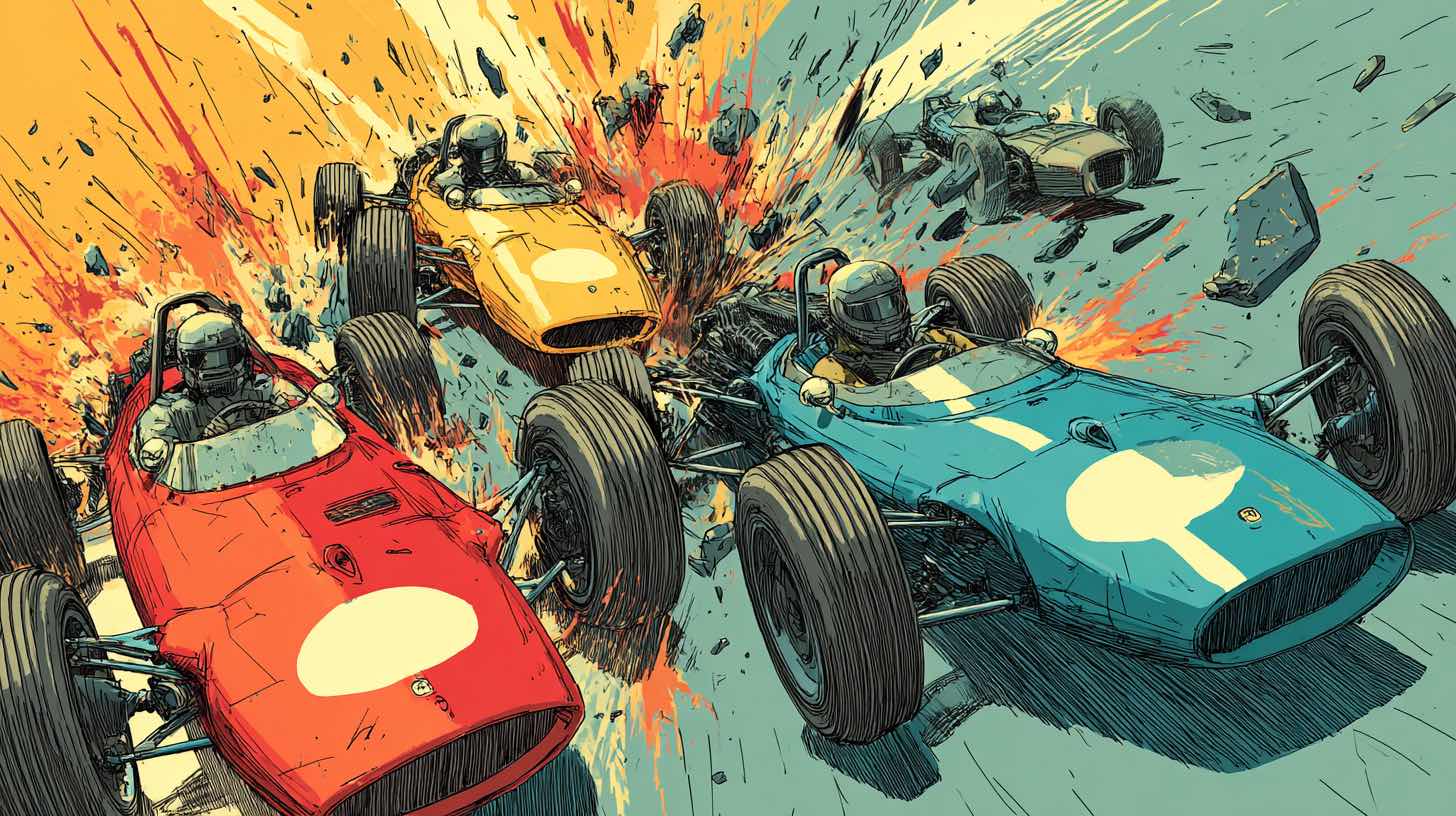
That’s the tax at human speed. Now compress the timeline: triple the output, triple the damage from every misalignment, and it happens before anyone notices. Drift apart at 20mph and you get a fender-bender – an awkward standup, a morning of rework. The same drift at 80mph is a pileup: wrong work, produced confidently, at volume. Throw it all out and start over. Goodbye AI budget.
The headlines have a genre for this now: “agents gone wild.” Uber burned through its 2026 AI budget in just 4 months (Bloomberg). The WSJ covered “vibe-coded AI slop” flooding codebases with buggy, dangerous code – leading to corporate America starting to ration AI outright. Those read like stories about autonomous agents run amok, Terminator-style. Mostly they aren’t. They’re about us – well-meaning cyborgs generating output faster than we can coordinate it with the team.
Old fixes don’t fit
The instinct is to patch the problem with tools already on the shelf: add a standup, build a dashboard, start another status channel in Slack.
Those rituals were built for human-pace work, and they were barely holding up even then. They sample the team’s state once a day or once a week, and they capture activity, not direction. Underneath them, the traditional coordination “duct-tape” stack – tickets here, docs there, threads everywhere – decomposes the work into fragments, and nobody ever recomposes it. There is no view, anywhere, that concretely answers “what is this team of cyborgs actually doing right now, and why.” So back to endless meetings we go.
The industry’s other answer is to throw everything at the machines. Context management for agents is becoming its own category: memory layers, retrieval pipelines, MCP servers that hand an agent read access to the codebase, the docs, the ticket tracker, meeting notes – everything the team has ever written down or said. This is sometimes useful, mostly wasteful token-wise, and still pointed the wrong way for this problem.
An agent that can read every byte still can’t tell you which of three open PRs is the real plan, why last Tuesday’s reprioritization happened, or whether that design doc reflects this week’s thinking or last quarter’s. Reading the artifact isn’t the same as knowing what it means. And on a real team, the harder problem runs in the other direction: the context locked inside each person’s private AI sessions, or in their head, never makes it back out to the humans sitting three seats over.
Loops of intent, not status
Here’s the reframe. The team isn’t missing activity data – activity is the one thing there’s too much of.
What’s missing is intent. What is each person, and each person’s agents, about to do, and why? What actually got done against these intentions? The teams that stay coherent at AI speed are the ones where declared intent and actual accomplishment get reconciled continuously in team-wide loops – not sampled in a Monday morning meeting that’s stale by lunch.
Intent is also where trust comes from. A teammate whose next move you can predict is a teammate you can leave alone; the same will be true of every agent your team ever runs. You can’t extend trust to a black box – human, cyborg, or machine – and without trust, all that speed stays on a short leash.
There’s an open-source methodology built for exactly this – Continuous Coordination – worth reading end to end. It runs that reconciliation on two loops. A big-picture loop ties the plan to the work: brief updates that connect team progress back to the goal, so anyone, human or agent, can check whether a task still matters. A ground-level loop is tighter and faster: short check-ins – previously, next, blockers – that broadcast what each teammate and their agents intend to do, so drift gets caught before it turns into wasted work. Close those two loops and the cyborg team stops leaking context, stops wasting tokens, and starts moving at agent speed as a team.
Where human-agent teamwork goes next
Everything above is true without a single autonomous agent on the team. Every person is still the operator; the AI is still a power tool with a human hand on it. Cyborgs.
That’s the part about to change. The next turn is the agent that stops being something you run and becomes something the team works with – it has a whole job of its own, it works while you sleep, and it either joins the team’s loops or wrecks them. This isn’t hypothetical. It’s already starting.
What that looks like when it works is coming up in the post in this 3-part series.
Steady is the human-agent teamwork OS – it keeps people and agents coordinated automatically by running team-wide loops of intentions and accomplishments.