TL;DR:
- Microsoft’s 2026 Work Trend Index Annual Report just named the AI moat: Owned Intelligence. It’s the institutional knowledge of how a firm actually creates value, the kind that compounds over time and can’t be ripped out.
- The headline finding: how a company is organized around its workers (culture, manager support, talent practices) accounts for about 2x more of AI’s real impact than the worker’s own AI use or attitude. The constraint is the system, not the people.
- Microsoft’s recommendations are mostly cultural and pretty thin. The actual system, where intent and outcomes get recorded across humans and agents, is where the report stops short.
- We call that architecture Continuous Coordination, and we publish the methodology in the open at continuouscoordination.org.
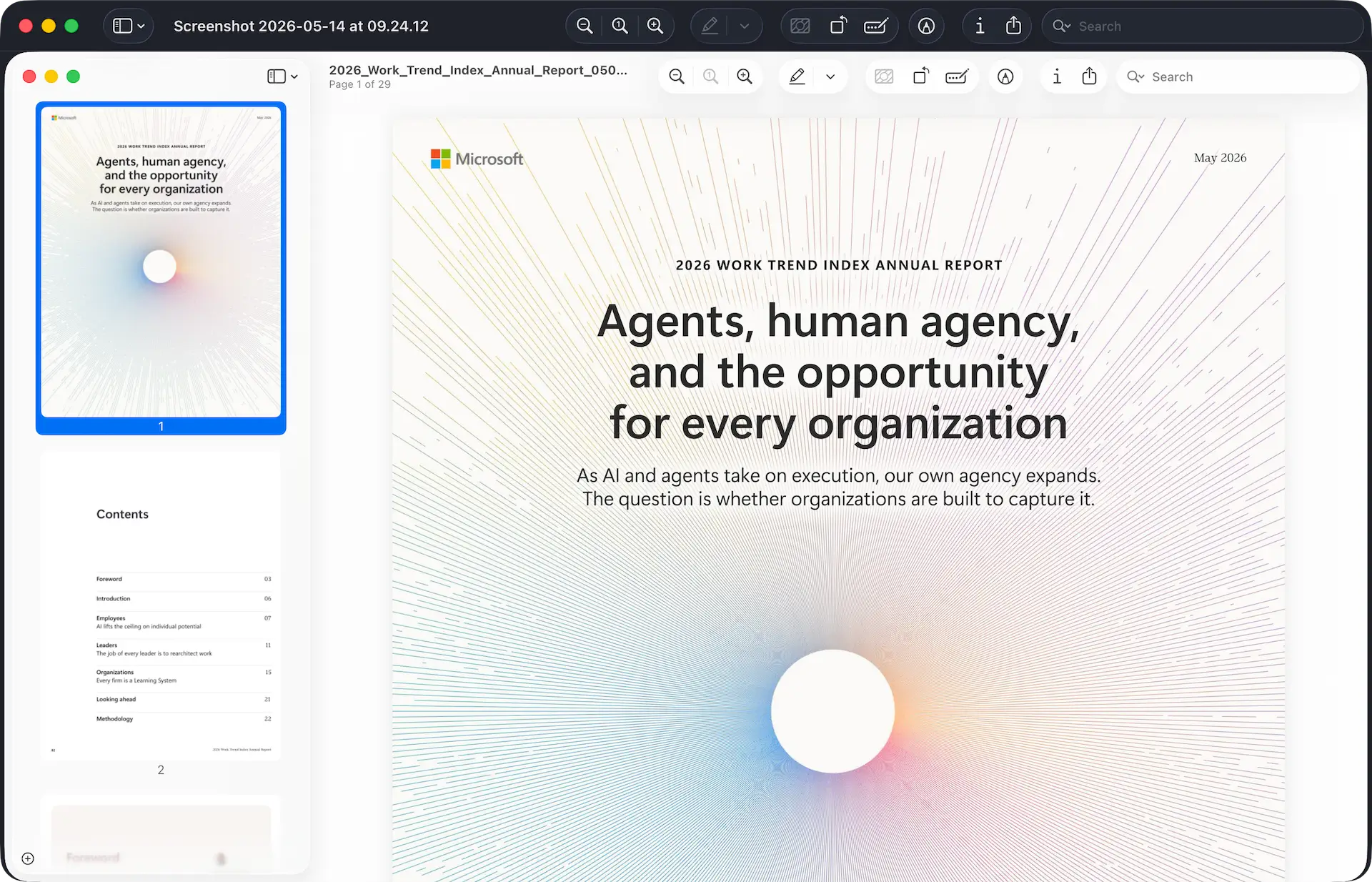
Microsoft’s 2026 Work Trend Index Annual Report dropped in May with a 22-page argument that the bottleneck for AI in the enterprise is not the tooling and not the workforce.
It is the operating model.
Employees are moving faster than their companies. Pilots scale, but advantage (and ROI) doesn’t, because the surrounding system isn’t built to absorb what agents now produce.
The report calls organizations that have figured this out Frontier Firms, the asset they build Owned Intelligence, and the architecture Learning Systems.
We’ve been arguing a version of this lately. We call it Continuous Coordination, and the architecture is a coordination layer that records intent and accomplishment for humans and agents alike. In our view, this is a useful report, but stops short of describing a real, working system.
Here’s our reading.
What the report says
The framing question is no longer whether AI matters, but whether your company is built to redesign itself around what AI now makes possible. Three findings carry the weight.
How a company is organized around its workers accounts for about 2x more of AI’s real impact than the workers’ own AI use or attitude. Microsoft ran a random-forest analysis across 19,854 respondents in 10 markets. Culture, manager support, and talent practices explain about 67% of reported AI impact. Individual mindset and behavior explain about 32%. The single strongest factor, “Org AI culture,” is roughly 2.5x stronger than the top individual factor. (WTI 2026, p.16)
Only 19% of AI users are in the “Frontier zone.” That’s the slice where individual capability and organizational readiness reinforce each other. 10% are “Blocked Agency”: skilled people in companies that haven’t caught up. About half of all respondents sit in an undefined “Emergent” middle. So capability is outrunning the system around it. (WTI 2026, p.12)
The number of active agents in the Microsoft 365 ecosystem grew 15x year over year, 18x in large enterprises. Agents are scaling. But the report’s own data shows the signals those agents generate (what worked, what failed, where outcomes drifted) “stay local or spread slowly” at most organizations. (WTI 2026, p.17)
From there, the report introduces the vocabulary it wants the industry to adopt:
- Frontier Firms. Organizations where individual AI capability and the surrounding system both rate high.
- Owned Intelligence. “Institutional know-how that compounds over time, is unique to the firm, and is hard to replicate.” (WTI 2026, p.19)
- Learning System. The architecture: “work continuously produces insight, and insight continuously reshapes how work gets done.” (WTI 2026, p.19)
The Foreword, written by Harvard Business School professor Dr. Karim Lakhani, sets out the stakes:
“The question is no longer whether AI matters. It is whether the firm is willing to redesign itself around what AI now makes possible.”
What’s true and useful
Three things in this report are correct and worth saying out loud.
The constraint is the system, not the people. Most enterprise AI conversations are still about training, prompt skill, and individual adoption. Microsoft’s data flips that. Twice as much impact comes from culture and manager support than from individual skills. The phrase “Transformation Paradox” (workers ready, systems not) is a useful name for a real shape we keep seeing in customer conversations. People aren’t the problem, the plumbing is.
Agents produce signals that have to be captured somewhere. This is the most important sentence in the report: “As agents take on more, they also generate valuable signals: what worked, what failed, where outcomes drifted. In many organizations surveyed, those signals stay local or spread slowly.” That gap is the difference between an experiment and a Frontier Firm. The agents work, but the organization doesn’t keep track of what works and what doesn’t. Without a system that captures intent before the work and outcomes after it, the agents run amok and the institution forgets.
Owned Intelligence is the right name for the moat. As execution gets automated and commoditized, every firm will have access to roughly the same model and roughly the same agent runtimes. What separates one company from another is the accumulated record of what was intended, what was actually done, and the routines built around it. That asset compounds, is unique, and can’t be ripped out. Microsoft has put a clean name on something a lot of us have been circling for a while.
What’s underdetermined
This is where we’d push back, gently.
The report describes the outcome of a “Learning System” but not the system. “Work continuously produces insight, and insight continuously reshapes how work gets done” is a fine outcome statement. It is not a system. The prescriptions Microsoft offers around it are mostly behavioral: managers should model AI use, leadership should align on strategy, talent practices should reward reinvention. All true. None of it answers the question of where the signals live, how intent and outcomes are recorded across humans and agents, or what software shape turns a pile of agent executions into Owned Intelligence.
The “Four Modes of Working with AI” are about one human and one agent. The 2x2 framework on p.9 (Delegation, Collaboration, Asking, Exploration) is useful, and we’ll probably steal it for our own onboarding. But every quadrant assumes a single human in a session with a single agent. The harder problem, and the one we hear most often from customers, is multiplayer. What happens when agents are performing a jobs autonomously for a team, and those agents act on overlapping data and instructions? Whose goal did the agent execute against? Who reviewed the output? When the agent made a decision in the background, how does the rest of the team find out? The report touches this obliquely in the IT and Security paragraphs (lifecycle management, auditability) but the framework itself never gets there.
“Three questions every Frontier Firm needs to answer” is a system-of-record question. Microsoft says every Frontier Firm needs to answer: Who reviews agent performance? Who has authority to update agent workflows? How does a local win get scaled across the organization? These are organizational design questions, and they are also data questions. You can’t answer “who reviewed this agent’s output” without a place that recorded the review. You can’t scale a local win without a place that recorded the win. Owned Intelligence requires a substrate and the report doesn’t name one.
How to apply this if you’re running an AI strategy
Two reads worth taking back to your own company.
Stop measuring adoption. Start measuring absorption. The report contrasts “AI absorption” with “AI adoption” once, in a single sentence on p.15, but it’s the most useful distinction in the document. Adoption is licenses and prompts-per-user (or worse, “tokenmaxxing”). Absorption is whether the signals from those events change how the next piece of work gets done. If you can’t tell the difference at your company, you’re running an arguably shaky pilot, not building a Frontier Firm.
Pick one coordination loop and instrument it end to end. Pick a single team and a single recurring loop (a weekly sync, a quarterly planning cycle) and answer Microsoft’s three questions for it in writing. Who reviews the agent. Who can update what the agent does. How does what we learn move beyond this team. You’ll discover quickly that doing this without a shared system means doing it in Slack threads, Notion pages, and meeting recordings. That tangle is the “duct-tape stack” the report doesn’t name but we see so often. It’s also a big reason 9 out of 10 enterprise agents never reach production.
Where this connects to what we’re building
Steady is the coordination layer for humans and agents. The data structure underneath it is a continuous record of declared intent and reported accomplishment, contributed by people through Smart Check-ins and Goal Stories, and by agents through the same surfaces. The report’s “Learning System” describes the what. Continuous Coordination is our argument for the how: a shared, durable place where intent lands, outcomes get attached to it, and the institution carries what its agents learn from one execution to the next.
We started this work before agents were on most people’s radar, because the same shape applies to human-only teams. Microsoft’s data confirms the bet.
The companies that pull ahead are the ones whose connective tissue keeps up with the speed of their AI.
If you want the short version of where this is headed, it’s two sentences. Execution will be rented. Coordination will be owned.
Where to start
If you want to see what an architecture for this could look like in practice, we’ve been working on one in the open. Continuous Coordination (sometimes called CoCo) is a lightweight methodology that distills 50+ years of running knowledge work teams into seven concrete practices, organized around two loops: a big-picture one that connects plans to progress, and a ground-level one that keeps teammates in sync. There’s a getting-started guide, the practices, an open JSON Schema, and a reference server implementation.
Start at continuouscoordination.org.