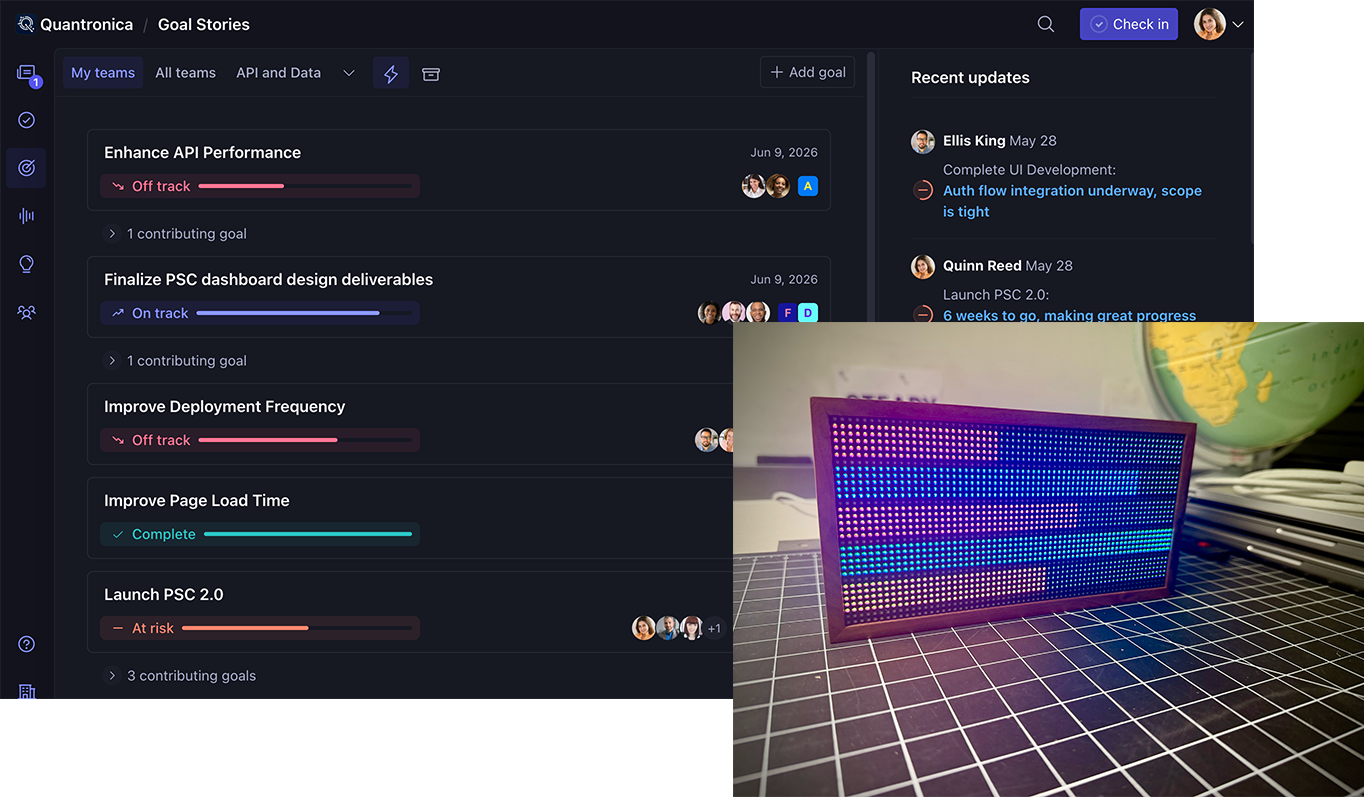
There’s a small LED display on my desk – 64 pixels wide, 32 tall – showing my team’s daily check-ins as a grid of colored dots. Who’s in, who met their intentions, who’s blocked. I can read it from across the room. The display flips between that and a colored view of our goals in flight: percent complete along with a color-coded status.
After we shipped the API v2 and the MCP server, we started making apps for ourselves. A menu bar app that reads your latest digest entry out loud. Another that pins your intentions for the day to your desktop. A daemon that selectively watches your Claude Code sessions and quietly posts what you worked on to Steady, surfacing and distilling all that work for your team.
Today we’re putting them in a public repo: the Steady Playground.
Why a playground
Steady is headless. The web app is one way in, but the system is reachable through the API and MCP server, which means Steady can show up wherever your team already wants it: a menu bar, a terminal, an agent, a strip of LEDs. We thought sharing the stuff we built for ourselves was a neat way to show this concept in action. But these aren’t “official” apps – they’re just demos of what Steady can do.
What’s in it
Each app lives in its own directory with its own README: what it does, which Steady surface it uses, how to run it, how to fork it.
- claude-code-activity-summarizer – a Dockerized daemon that summarizes your Claude Code sessions every few hours and posts the themes to Steady as activity.
- macos-menu-digest-announcer – click the menu bar icon, see (and hear) your latest digest entry.
- macos-desktop-intentions – your intentions for the day, right on your desktop.
- tidbyt-check-ins – the LED grid on my desk.
- tidbyt-goal-stories – every top-level goal as a stacked progress bar. Color is status, width is progress.
More are in the works – kiosks, mood boards, etc.
These are demos, not products. We’re shipping them roughly as we wrote them, MIT licensed, no polish promised (but we use them!).
Build your own
Everything here runs on a personal access token – generate one, drop it in a .env file, and you’re talking to the same API we use. The API docs and MCP docs cover the rest.
If you build something on Steady – useful, silly, weird, doesn’t matter – open a PR adding it to the table, or just send us a link. We’ll feature the good ones in a follow-up post.