Continuous Coordination is an open method for modern teamwork. It keeps a team – humans and AI agents alike – aligned and in sync through two automated coordination loops, instead of meetings, busywork, and token waste. It’s built on seven practices, layers on top of the tools you already use, and is published in the open under a CC BY-SA 4.0 license.
TL;DR:
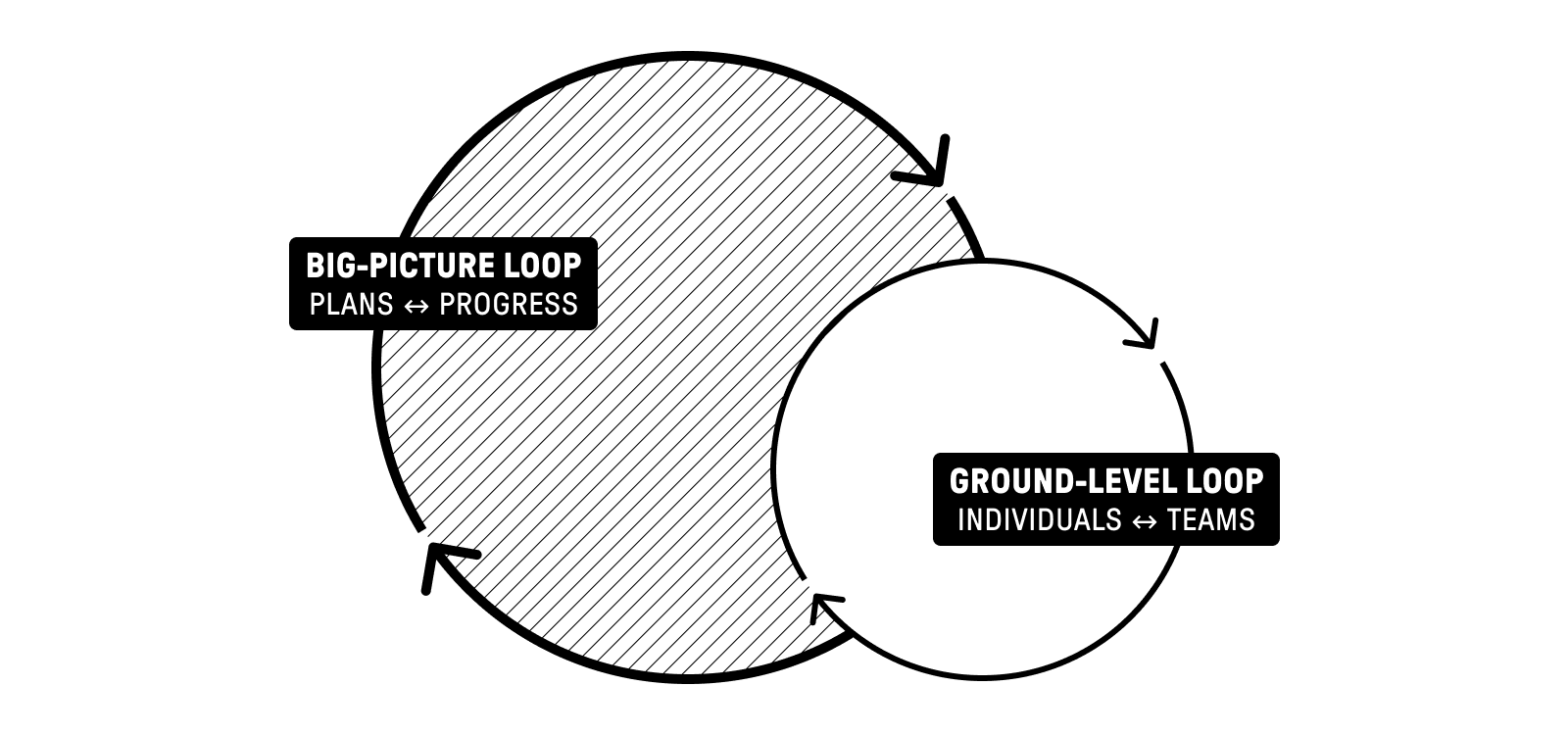
- Teams run on two coordination loops: a big-picture loop that connects plans to progress, and a ground-level loop that keeps teammates in sync day to day. Most teams close neither one cleanly.
- Everyone now works with personal agents – coding, research, writing – shipping more work that needs trust and validation. Tight coordination loops get the context right before the work starts.
- Autonomous agents now hold jobs, not just tasks. They must run in the same loops as their human teammates, or they ship wrong work at speed.
- Continuous Coordination is seven proven practices for closing both loops automatically, for humans and agents together.
- It’s an open method with an open JSON schema, developed by people with decades of experience in digital product and service organizations. It layers on top of your existing tools and is easy to adopt.
The last mile of human-agent teamwork is coordination
Knowledge work – thinking and constantly making decisions, large and small – is impossible without context. Who’s doing what, what changed, what’s at risk, and most importantly why the work matters. From writing code to prioritizing a roadmap, people and AI agents need a steady stream of this context to work effectively.
Getting that context to the right people and AI agents at the right time is the last mile of teamwork. And most teams cover it with a duct-tape stack: meetings, chat threads, dashboards, ad-hoc automations, and manual status updates stitched into something incomplete, inconsistent, and inefficient. We end up communicating with our tools instead of each other. It’s a productivity-killing, morale-sapping burnout machine, and we’ve been readily accepting it as the status quo.
Now there’s a new wrinkle, and it’s arriving in two forms. The first is already everywhere: people working with their own personal agents – coding assistants, research assistants, writing tools. Each person now ships more work, faster, than they could alone. But more output is more that needs trust and validation before anyone can rely on it. The only way to keep that from turning into rework is tight, structured coordination loops that get the context right before the work starts, not after.
The second form is autonomous agents that hold jobs, not just take on tasks – answering phones, qualifying leads, managing incidents, shipping code. Same problem, larger: they produce even more work that needs trust and validation, and they can’t lean over and ask what changed. To do their jobs, they have to consume the same context, in the same coordination loops, as their human teammates. An agent that operates outside those loops is a teammate who never comes to standup and never gets told when priorities change. It keeps working. It just keeps working on the wrong things, at speed.
That’s the problem Continuous Coordination solves: closing the last mile for everyone on the team, a human or agent.
Teams run on two loops
Every team and company runs on two foundational coordination loops.
The big-picture loop connects plans to progress across teams and the company. Are we on track? What changed? What are the risks? Why does this work matter?
The ground-level loop keeps teammates in sync day to day as they do the big-picture work. What are you working on? What’s in your way? What do you intend to do next? This is the pulse of the team.
These loops were barely closing when teams were all human. Add agents, and an open loop doesn’t just cost time, it compounds into rework. Continuous Coordination is a method for closing both loops automatically, so the context flows without anyone – or any agent – having to assemble it by hand.
The seven practices
Continuous Coordination is a set of seven practices for digital product and service organizations. The goal is constantly delivering the distilled context a team needs to collaborate, without requiring people to burn time and energy assembling it themselves. The results are substantial gains in productivity, work quality, and engagement – and a coordination model that holds up when agents are teammates too.
Here is the what and why for each practice:
1. Keep a steady beat
- What: Use automated communication loops to routinely and proactively distribute work activity, plans, mission, and vision.
- Why: Ad-hoc approaches to keeping everyone informed and aligned are brittle, time-consuming, and tedious. Automated loops keep everyone in tight sync without all the effort and interruptions.
2. Lead with context
- What: Always give people the why for the work, not just the what and the when.
- Why: High-autonomy teams are high-functioning teams. Move the business forward by regularly giving people the context and coaching they need to make independent decisions. The same context is what keeps an agent on task instead of drifting.
3. Work in the open
- What: Share objectives and progress against them throughout your organization.
- Why: Transparency is the foundation of trust, the key ingredient for high-performing organizations. Plus, working in the open keeps stakeholders and adjacent teams up to speed without asks and interruptions.
4. Tell the future
- What: Include intent in all coordination communication.
- Why: You can learn from history, but you can change the future. When contributors communicate intent, leaders can course correct before days, weeks, or months get burned. When agents express intent, you can catch wrong work before it ships, not after.
5. Spare the meetings
- What: Save meetings for the high-value stuff – collaborating, team-building – and use asynchronous tools for the rest.
- Why: “Meeting hours” are the most precious commodity in a knowledge organization. They carry a high cost but are incredibly valuable when used correctly. Don’t squander them.
6. Write it down
- What: Default to writing for progress updates, strategy briefs, and the communication of intent.
- Why: Writing is the ultimate idea clarifier, refining ideas into their sharpest form before they get shared. It ensures messages aren’t just heard, but understood. A culture of writing leads to stronger alignment for less effort – and a written record is exactly what agents read from and write to.
7. Track output, not input
- What: Discard “performance” metrics that don’t correlate with desired outcomes.
- Why: When it comes to knowledge work, real productivity isn’t measured by hours clocked, meetings attended, or lines of code written. Focus on output and outcomes instead.
Getting started
Continuous Coordination isn’t designed to replace your tools, processes, or communication channels. It’s a lightweight overlay that solves the underlying problems that hold organizations back: miscommunication, opaque vision, fractured context, micromanagement, and misalignment. You can adopt it without overhauling how you work.
There are three ways to start, ordered by how much you want to automate.
1. Practices only
Adopt the practices by hand, no new tooling required. Each one stands on its own, but they reinforce each other, so start with the keystone: Keep a steady beat. Make it stick with three things – a consistent reminder, so participation isn’t voluntary; a consistent format, intent plus progress; and a consistent place, one uncluttered spot everyone reads. A daily Slack thread or a calendar nudge is enough to begin. Best for teams testing the waters before committing.
2. Practices plus a CoCo server
Run the practices against a dedicated coordination server, using the open reference implementation or your own build. The server gives you a consistent format and place out of the box, and lets autonomous agents read from and write to the same loops over the API. You add the reminders, scheduling, and any interface yourself. Best for teams that want DIY agent integration or have custom requirements.
3. Practices plus Steady
Steady is the turnkey implementation. Smart check-ins close the ground-level loop, goal stories close the big-picture loop, and Echoes distill it all into personalized intelligence for every teammate – with reminders, Slack and Teams integration, an API and MCP server, and built-in agents, all included. We’re now extending those same loops to include agents as teammates. Best for teams that want a complete solution with native agent support. Join the beta if that’s the problem you’re feeling.
See the getting started guide on the Continuous Coordination website for the full walkthrough.
Digging deeper
Explore these resources to learn more or get involved in the development of Continuous Coordination:
- Visit ContinuousCoordination.org
- Read the seven practices in full
- Download the PDF reference guide
- Explore the open JSON schema on GitHub
- See how Steady implements the practices